
'Not a democratic ally': Canadian PM Carney visits Mexico to push closer ties
Canadian Prime Minister Mark Carney travelled to Mexico to thaw frosty ties. President Claudia Sheinbaum greeted his trip with talk of Canadian mining companies' supposed environmental shortcomings.

This story was commissioned by a major international media outlet, but was not published.
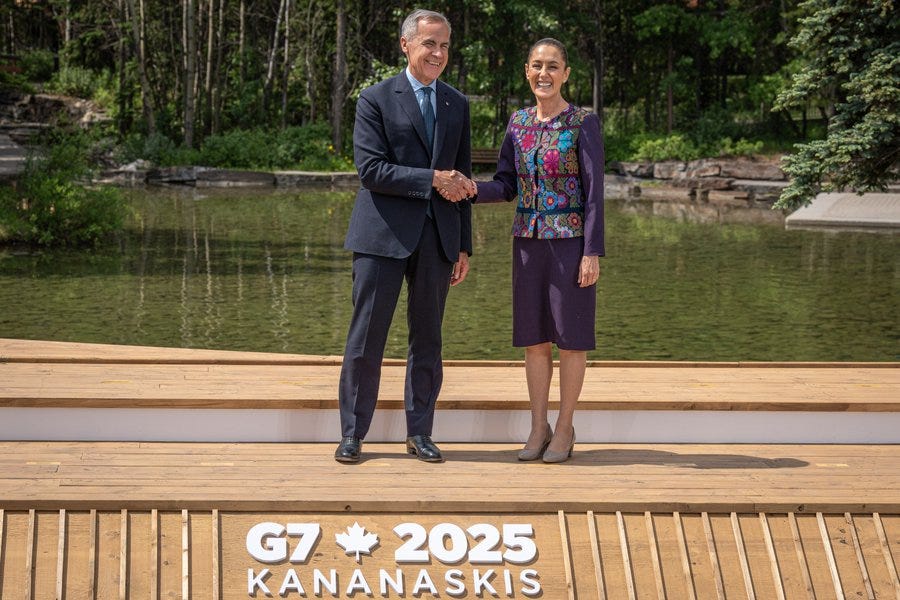
Prime Minister Mark Carney visits Mexico on Thursday for a two-day visit aimed at boosting relations and strengthening trade ties after years of mutual disinterest, commercial disputes and calls from Canadian politicians to cut Mexico loose to preserve tariff-free exports with the United States.
The visit puts trade at the forefront ahead of a scheduled 2026 review of the Canada-U.S.-Mexico agreement (USMCA) as both countries attempt to diversify export markets amid U.S. tariff threats.
“Canada is not going to send mounted police to rescue Mexico from the DEA. We know that,” said Federico Estévez, political science professor at the Autonomous Technological Institute of Mexico. “What’s credible from Canada, insofar as Mexico is concerned, after Canada has done nothing for years?”
Thorny issues remain, however, such as Canadian visa requirements for Mexican visitors. And President Claudia Sheinbaum has promised four times over the past six weeks to raise complaints with Canadian mining companies. She said Wednesday:
“I always mention this: on the issue of Canadian mining, they have to comply with all environmental regulations, which they haven't necessarily met.”
She also added, “We obviously want to maintain the trade agreement between Mexico, the United States, and Canada. Fortunately, working groups related to its revision are already underway.”
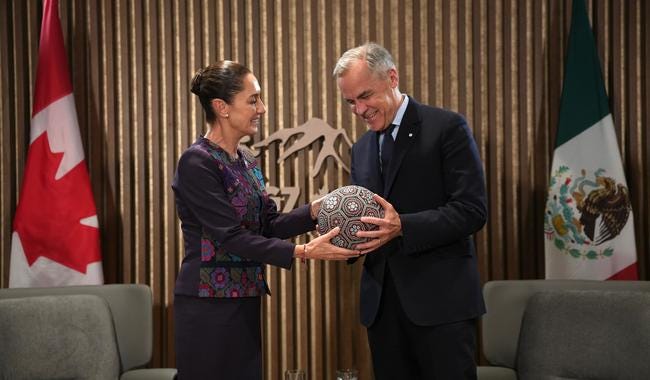
Mr. Carney has prioritized re-engaging Mexico after years of neglect. He invited Ms. Sheinbaum to the G7 Leaders Summit in Kananaskis, Alta. – the first time a Mexican President visited Canada in nine years. The commercial relationship remains robust with trade totalling more than $55 billion in 2024, according to the Conference Board of Canada. (Mexico sent five times more exports to Canada than Canada sent south.)
Democratic backsliding?
But the prime minister’s visit comes amid concerns of democratic black sliding in Mexico as Ms. Sheinbaum continues the dismantling of autonomous institutions such as the country’s version of Access to Information, the electoral authority and the courts. It was a process started under her predecessor and mentor, former President Andrés Manuel López Obrador.
Hundreds of new judges were sworn Sept. 1 after being selected in an election drawing a crushing disinterest with barely 13 per cent participation. All nine supreme court justices are considered aligned with the ruling Morena party – whose operatives spread candidate cheat sheets in what was supposedly a non-partisan election. The elections came after Mr. López pushed a judicial reform after feuding with former court president Norma Piña and badmouthing decisions such as injunctions stopping megaprojects for violating environmental regulations.
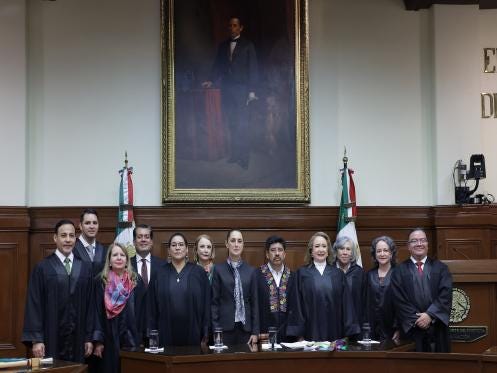
Sheinbaum has also called for electoral reform to overhaul the autonomous electoral institute, which Mr. López Obrador alleges cheated him out of the 2006 election. It’s matter that Ms. Sheinbaum continues relitigating.
Polls, however, show Mexicans more satisfied with democracy than ever. The latest Latinobarómetro survey of Latin American attitudes showed Mexican satisfaction with democracy hitting its highest level since 1995.
Diminishing poverty and deftly negotiating with Mr. Trump has sent Ms. Sheinbaum’s approval rating soaring to 75 per cent. Analysts attribute her popularity more to domestic policies – such as expanding cash stipend schemes and raising the minimum wage – along with a populist style of politics.
“The secret of her success is the social programs” and “being out in the street” and pressing the flesh on tireless tours of the country, said Aldo Muñoz Armenta, political science professor at the Autonomous University of Mexico State.
Ms. Sheinbaum has made political hay out of the anti-poverty programs. She claimed in her annual informer (state-of-the-nation address) that inequality dropped so drastically that Mexico only trailed Canada as the country with the lowest inequality in the hemisphere.
The claim came under quick scrutiny: fact-checking watchdog Verificado confirmed inequality slid in Mexico between 2022 and 2024. But the country ranked No. 14 in the Americas trailing the U.S., Uruguay and Chile.
The claim, however, came amid data from INEGI the state statistics service showing a nearly 18 per cent drop in the poverty rate. Analysts attributed the drop in poverty to policies such as hiking the minimum wage and creating cash transfer schemes implemented by Mr. López Obrador and continued by his protege, Ms. Sheinbaum.
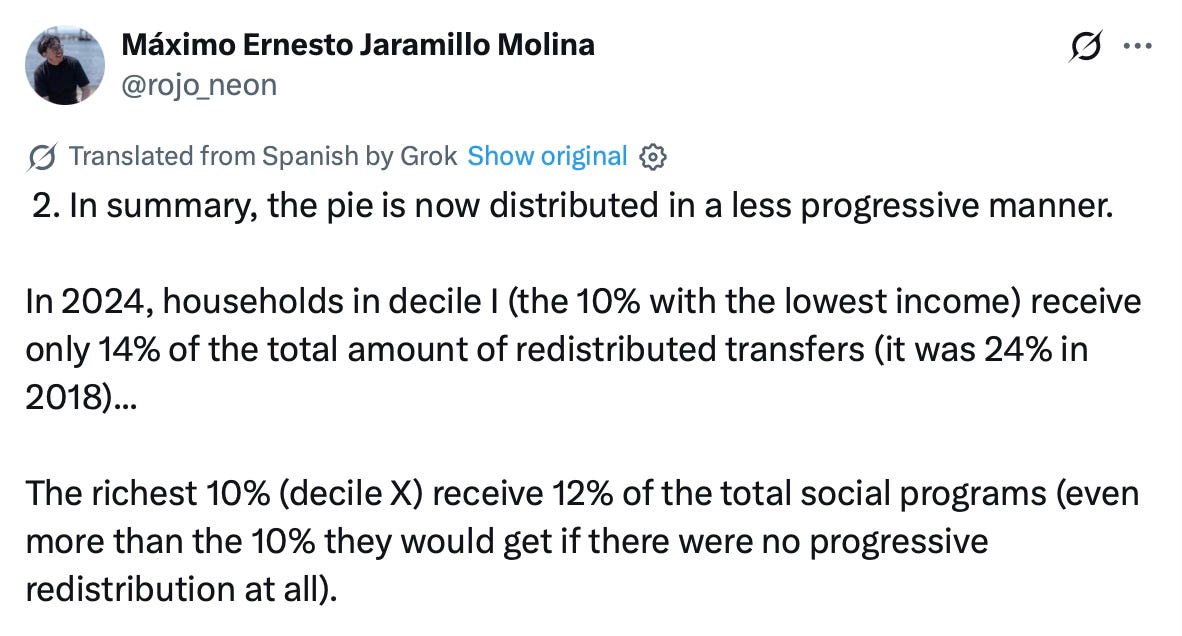
Critics, meanwhile, didn’t deny the poverty fell. But they questioned the figures – such as the poorest decile of Mexicans receiving less of a share of social spending than when Mr. López Obrador took office in 2018 and the fact the agency measuring poverty was shuttered.
Mexico has confronted economic headwinds in Ms. Sheinbaum’s first year in office. Scotiabank forecast Mexico’s economy to contract by 0.1 per cent in 2025, saying in an August note, “The path for growth in Mexico remains highly dependent on the evolution of U.S. trade policy.”
Ms. Sheinbaum’s hopes for a boom in nearshoring – the process of companies moving supply chains from China to North America – have faded with Mr. Trump’s tariff policies.
In August, Mr. Trump postponed higher tariffs on Mexican goods complying with the USMCA. Some 84 per cent of Mexican goods are USMCA compliant, according to the Economy Secretariat. Mr. Ramírez said:
“We could say that with what Trump threatened and compared to what’s happened these past eight or nine months with this U.S. government, we’ve done reasonably well.”
Analysts see the need for Canada and Mexico to forge stronger ties ahead of the 2026 USMCA review and to prevent U.S. President Donald Trump from pursuing separate agreements with both countries. But analysts also see limits in pursuing an agenda beyond commerce or confronting Mr. Trump, stemming from past neglect and misunderstandings.
Mexico’s embrace of populist politics also presents challenges.
“Mexico is not a democratic ally because it has been losing its democracy for at least six years,” said Solange Márquez, political science professor at the University of Toronto. “There’s been an erosion of institutions,” she added. “They haven’t sought any kind of negotiation or consensus” with the opposition. “It has an anti-democratic tone.”
As always, great reporting and analysis!